Kubernetes Vs Docker: Which One Is The Better Choice?
Share :


9 years ago when Docker was released in 2013, it disrupted an era of container technology in the software development industry. Its ability to automate the deployment of applications in portable and lightweight containers made it a widespread technology across the globe.
And just one year later, when Google launched Kubernetes for efficiently managing containerized applications, Kubernetes and Docker both became popular buzzwords.
In the current software, SaaS Application Development, and cloud computing field, Kubernetes and Docker stand out at the top due to their excellent abilities for creating and managing containerized applications. But many developers and business owners often feel difficulty in Kubernetes vs Docker for choosing the suitable one.
So we decided to sort out this perplexity through this blog. If you are a DevOps Engineer, IT architect, or software developer, then know which container technology fits best to your requirements between Kubernetes vs Docker.
Key Difference Between Kubernetes and Docker
Docker is known as a containerization platform and runtime. Whereas, Kubernetes is a platform used for effectively managing and running containers from various container runtimes. We can say that Kubernetes is a larger concept that supports multiple runtimes, including Docker.
Back in 2013, when Docker was introduced to developers, it allowed them to explore the modern era of containers and started a new age of computing based on microservices. Moreover, these containers don’t have to be dependent on their own operating system.
They can provide the development of highly scalable and loosely-packed microservices. The development teams can easily pack an application, its dependencies, and configuration files all together as a container image.
However, with time, the applications also grew their complexity. They have to hold various containers spread across various servers with different complex challenges. These challenges included coordinating, scheduling, communicating, scaling, and more.
What is Kubernetes?
Kubernetes is known as a famous open-source container orchestration platform. Prominent businesses use this solution for effective container management in various private, public, and hybrid cloud platforms. It is possible to use Kubernetes with or without Docker.
To run billions of containers on a very large scale, Google created Kubernetes. Kubernetes was released as an open-source platform in 2014 and became a market leader for managing containers and applications. The main goal was to simplify the deployment and management of distributed systems.
Kubernetes consists of a set of containers present in a group to effectively manage the machine in order to reduce the network load and drastically improve the efficiency of resource usage. Moreover, this platform is especially enjoyed by DevOps teams since they are able to enjoy service discovery, load balancing, automated rollouts, rollbacks, and a lot more.
Benefits of Implementing Kubernetes
Kubernetes has become a choice of DevOps engineers and software developers. It is widely used in the software and cloud computing sector due to the following benefits-
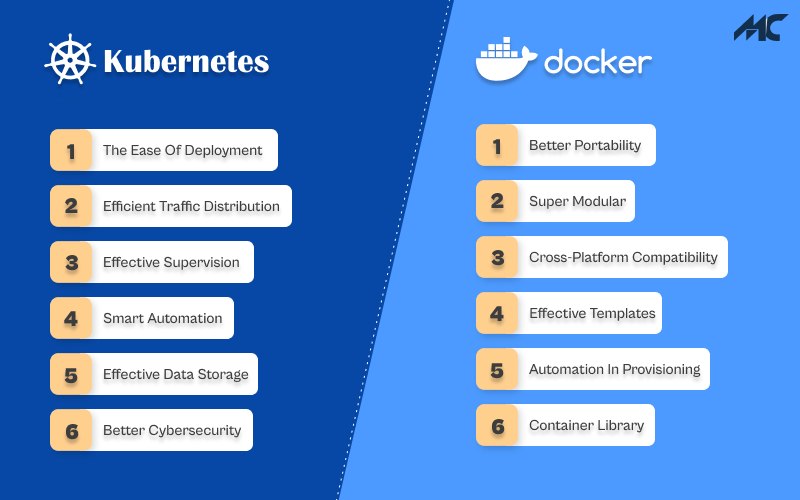
The Ease of Deployment
It becomes incredibly easier for users to choose, configure, and modify the different states for the deployment of containers. Thus, they can easily create new container instances, migrate containers, and delete the old ones.
Efficient Traffic Distribution
The Kubernetes platform is also very popular for handling impeccable load-balancing operations. Thus, this helps in the effective traffic distribution around various container instances.
Effective Supervision
Kubernetes makes it possible for the users to closely monitor the exact container health. Therefore, the developers have the ability to restart the malfunctioning containers in order to fix them.
Smart Automation
Kubernetes works with an intelligent layer of automation and useful features. Thus, the developers are able to save a lot of time and effort while creating and managing the containers.
Effective Data Storage
Kubernetes is famous for supporting the storage of container data around different types of storage such as local, cloud, and hybrid.
Better Cybersecurity
Kubernetes is a highly secure platform with full support for the secure management of tokens, passwords, SSH keys, and other important data.
What is Docker?
Docker is basically a containerization platform and runtime commonly used by developers in building, deploying, and running containers. It is reliant on a client-server architecture that works with straightforward commands and automation via a single API.
Moreover, Docker is also very popular for facilitating a complete toolkit for packing applications into immutable container images. Developers create these images by writing a Dockerfile and then using the relevant command with the help of the Docker server.
It is possible to create containers without Docker, however, the Docker platform makes the job incredibly easier. Above all, developers can deploy and run these container images on almost any platform that supports Kubernetes, Docker Swarm, HashiCorp Nomad, or Mesos.
A prominent Mobile App Development Company also has specialization in the Docker platform for mobile cloud computing. The main advantage of Docker is its capability of enhancing the development speed of applications and operating systems. Additionally, the users using the Docker platform are able to manage their frameworks just like they use their applications.
Benefits of Implementing Docker
Docker is a disruptive containerization technology. Its ability to create, run and deploy applications in containerized forms makes it a useful technology for developers. So let’s take a look at what reasons Docker is used in the industry.
Better Portability
The Docker platform makes it possible to deploy the containers to any cloud environment, data centre, or endpoint. Moreover, no modifications are necessary to make this happen.
Super Modular
It is possible for the users to integrate various processes into a single container. Thus, the containers are highly modular and can help in creating a custom mobile application that can even work while being updated or repaired.
Cross-Platform Compatibility
The Docker containerization platform is compatible with multiple operating systems such as Linux, Windows, and macOS. Moreover, it also works surprisingly well with leading cloud platforms including AWS, IBM Cloud, Azure, etc. Especially, mobile app development companies and developers extremely depend on these cloud providers for creating, deploying, and operating cloud-based mobile applications.
Effective Templates
The Docker platform is popular for supporting containers as base images. Thus, these base images can work as templates during the creation of new containers.
Automation in Provisioning
The Docker platform effectively utilizes the application source code to manage the containers automatically.
Container Library
This platform provides access to a huge library of containers readily available with the help of an open-source registry.
Versioning System
The Docker platform can work and track different versions of container images and maintain records of version creation effectively. Ultimately, the developers are able to build containers in different languages without ruining the lines of code.
Kubernetes and Docker: Using Them Together
It is quite difficult to make a comparison between Kubernetes and Docker because both aren’t equivalent technology terms. In fact, we can say that Docker is like an airplane, while Kubernetes is like an airport. Thus, you will be needing both to make the complete journey.
You will need Docker for creating containers, while Kubernetes will be helping you to manage those containers. When there are a large number of containers Kubernetes appears as the best solution to manage several containers efficiently. Big enterprises are in constant need to use Kubernetes for their containers while emerging start-ups might not even need Kubernetes to manage their applications.
The constant growth of a company also leads to changes in infrastructural needs, and the number of containers will also increase. This is where Kubernetes comes into the picture. Using them together helps organizations in enabling digital transformation and enjoy the benefits of modern cloud architecture. Together, they help in faster app deployments and releases.
The Bonding
It is not enough to run the containers in production, you will need the support of Kubernetes to regulate their auto-scaling, health checks, and load balancing. Thus, these features help in managing the lifecycle of the container. Kubernetes helps IT architects to consistently monitor the state of application deployment.
In simple words, Dockers containers assist in isolating and packing applications or software with all their dependencies. In contrast, Kubernetes is useful in deploying and orchestrating your containers.
Kubernetes Vs Docker: Quick Comparison
Both Kubernetes and Docker are very popular choices for container orchestration platforms. The main difference is present in their use cases and complexity. Kubernetes is mostly preferred for handling complex applications, while Docker is preferable for ease of use and simpler applications.
Installation and Setup
Kubernetes is a highly customizable platform but is very complex to set up. Whereas, it is easier to set up and configure Docker.
Load Balancing
Docker is known for providing automatic load balancing, while you won’t find these features in Kubernetes. However, it is quite easier to integrate load balancing with the help of third-party tools.
Monitoring
Kubernetes is famous for having in-built monitoring tools with complete support for third-party tools. In comparison, you won’t find such in-built monitoring mechanisms in Docker. You can rely on some third-party applications for this.
Scalability
Horizontal autoscaling also provides scaling based on traffic with Kubernetes. Docker also provides on-demand autoscaling.
Table of Comparison Between Docker and Kubernetes
This table compares the different features of Kubernetes Vs Docker to give you a better idea:
| S. NO | Docker | Kubernetes |
| 1 | It manages a group of instances of Docker Engine. | It manages a group of hosts running compatible container runtime. |
| 2 | Bundled into Docker Engine | It is a standalone project and it is not connected to Docker. |
| 3 | It also works with Docker Engine | Kubernetes can work with any compatible container runtime. |
| 4 | You can control it with Docker Swarm | You can control it with Kubernetes |
| 5 | No possibility of cloud integration | It can be integrated with cloud providers like AWS |
| 6 | Auto-scaling is not possible | Kubernetes supports the auto-scaling of containers if necessary |
| 7 | It is a product of Docker Inc. | There are many distributors of Kubernetes such as vanilla Kubernetes, OpenShift, etc. |
Conclusion
The choice between Kubernetes and Docker is highly subjective and mainly depends on the desired results and project requirements. Both platforms are very important for creating, orchestrating, and managing containers in enterprise environments.
Despite having some similarities, they have huge differences in terms of architecture, critical features, and applications. Therefore, development teams must have expertise with these platforms to provide high-standard cloud-based microservices.
Being a professional web and mobile app development company MobileCoderz is proficient in using state-of-the-art container technologies in software and application development for delivering secure and high-performance IT solutions.
If you need assistance in developing custom software or any kind of application with modern technologies, our tech specialists can help you easily.
Schedule a Free Consultation and Speak with Our Experts.
-
 Elevate Your Startup With SaaS Application Ideas
 -
The Complete Guide to Digital Wallet App Development in 2023
-
Top 8 Innovative FinTech App Ideas for Startups in 2023